
 A new Swinburne study is addressing a core paradox: if quantum computing is solving problems that cannot be checked by conventional methods, how can we be certain the results are correct? Quantum computing has the potential to tackle problems once thought unsolvable in areas including physics, medicine, and cryptography. However, as efforts accelerate to build […]
Click the Source link for more details
If Quantum Computing Is Solving “Impossible” Questions, How Do We Know They’re Right?
Scientists Just Made AI at the Speed of Light a Reality
 Researchers have demonstrated single-shot tensor computing at the speed of light, marking a remarkable step toward next-generation AGI hardware powered by optical rather than electronic computation. Tensor operations are a type of mathematical processing that underpins many modern technologies, especially artificial intelligence, but they go far beyond the basic math most people encounter. A useful […]
Click the Source link for more details
Four Black Scholars Selected for New Faculty Positions – The Journal of Blacks in Higher Education

Four Black Scholars Selected for New Faculty Positions The Journal of Blacks in Higher Education
Click the Source link for more details
New X-Ray Imaging Shows a Buckyball Breaking Apart in Real Time
 FEL X-ray pulses captured the rapid reshaping and fragmentation of C60 molecules exposed to increasingly strong laser fields. The results expose gaps in current theoretical models and point toward new pathways for controlling molecular behavior with light. Revealing Many-Body Molecular Dynamics With Intense X-Ray Pulses A clear grasp of how many interacting particles behave inside […]
Click the Source link for more details
Hieroglyphs Reveal The Name Of Forgotten Maya Queen Ix Ch’ak Ch’een
Conny Waters – AncientPages.com – Ix Ch’ak Ch’een was a powerful Maya queen who ruled the ancient city of Cobá, located on the Yucatán Peninsula in present-day Quintana Roo, Mexico. Until recently, her story remained largely unknown.

Cobá Archeological Area. Credit: O.Mustafin – CC0
Cobá itself was a major Maya center, with an estimated population of around 50,000 at its peak and an extensive built-up area covering 30 square miles. The city is notable for its vast network of stone causeways and numerous stelae—carved monuments that record important events from the Late Classic Period (AD 600–900).
A significant breakthrough in understanding Ix Ch’ak Ch’een’s legacy came with the discovery and restoration of the Foundation Stone—a large monument inscribed with 123 hieroglyphs—by archaeologist Ana Calderón and conservator Eunice Corazón Peralta. This artifact was found near a waterhole close to Cobá’s Nohoch Mul complex.
Epigraphers David Stuart (University of Texas) and Octavio Esparza Olguín (UNAM) analyzed inscriptions on this monument, identifying Ix Ch’ak Ch’een as a key ruler whose name also appears on other monuments throughout Cobá. Their research revealed that she held the title kaloomte’, or “Supreme Warrior” queen—a position established at Cobá on May 12, 569 C.E., during ceremonies at Kehwitznal (“the mountain of the deer”), part of one of Cobá’s most prominent architectural groups.

The Foundation Rock. Credit: INAH
The inscriptions document her involvement in significant events, such as inaugurating a ballcourt and marking important calendar cycles, including the seventh k’atun in AD 573, demonstrating her central role in legitimizing royal power through ritual activities.
Further analysis suggests that Ix Ch’ak Ch’een may have had political ties to Testigo Cielo, ruler of Kaanul (the “Snake Dynasty”), indicating possible alliances or diplomatic exchanges between these major powers.
Notably, the Foundation Rock is unique as it is directly associated with water—a vital resource symbolizing life for the Maya—and features references to mythical entities like witz’, linking natural elements to religious beliefs. This connection highlights how political authority was intertwined with sacred landscapes.

The Stela that revealed the name of the Maya queen Ix Ch’ak Ch’een. Credit: INAH
As stated in the press release, the ongoing study coordinated by Mexico’s National Institute of Anthropology and History (INAH) has provided valuable insights into both ancient Maya political structures and women’s roles within them. The discovery significantly advances our understanding not only of Ix Ch’ak Ch’een herself but also broader aspects of dynastic history among Classic-period Maya societies.
See also: More Archaeology News
The research team emphasizes that these findings are preliminary. Their next steps include preparing a comprehensive report on the Foundation Stone’s inscriptions and investigating Ix Ch’ak Ch’een’s impact on Maya society further. Experts anticipate that the upcoming phases of the Promeza Cobá Project will uncover additional information about this historical figure and her significant role in establishing one of the most influential political centers in the northern Yucatán Peninsula.
Written by Conny Waters – AncientPages.com Staff Writer
Click the Source link for more details
Researchers Reveal a Shockingly Fast Muscle-Healing Mechanism
 Scientists found that certain macrophages form neuron-like connections with muscle fibers and deliver calcium to jump-start repair within seconds. This rapid signaling sped healing in both injury and disease models. The discovery could open the door to new regenerative therapies. But researchers still need to understand why this repair boost doesn’t reduce pain. Cellular Complexities […]
Click the Source link for more details
Mystery Of The Controversial Jordan Lead Codices Solved? Perhaps Not
Jan Bartek – AncientPages.com – The Jordan Codices are a set of sealed books discovered in Jordan that have captivated scientists and historians alike. Some scholars have proposed that these lead “books” could date back to the early Christian era, a period when sealed books held particular significance in religious visions and teachings.
However, their authenticity remains highly contested. While some believe the codices are genuine artifacts from the 1st century CE, others argue they may be modern creations intended as tourist souvenirs or even deliberate forgeries.

Scientists study a sample from the Jordan codices. Credit: University of Surrey, AncientPages.com
Analysis Of The Jordan Codices
To address these uncertainties, researchers have undertaken comprehensive scientific analyses to determine the true origin of the Jordan Codices. The most detailed assessment to date has been conducted by a team at the University of Surrey’s Ion Beam Centre. This study offers new insights into whether these enigmatic objects can indeed be traced back to early Christianity or if they are products of more recent times, contributing valuable information to an ongoing scholarly debate.
In this recent study, researchers found that while the outer pages of one of the books showed signs of contamination from environmental exposure—making age determination difficult—the inner pages were much less affected and provided clear scientific evidence that they are at least 200 years old, if not older.
The research team collaborated with the University of Glasgow, the Scottish Universities Environmental Research Centre, and the University of Vienna to analyze samples from the books using four different techniques: trace-element analysis, lead-isotope measurements, alpha-particle tests, and radiogenic helium analysis. These methods helped assess both the composition and likely age of the lead used in the codices.
Although no single technique could establish an exact age on its own, combining their results offered a more comprehensive understanding of how various parts of these ancient texts were created.
The Age of The Jordan Codices Remains Unknown
Current tests have not established a definitive age older than 200 years for the codices, but they also do not exclude that possibility. This leaves room for further analysis using more advanced and precise testing methods in the future.
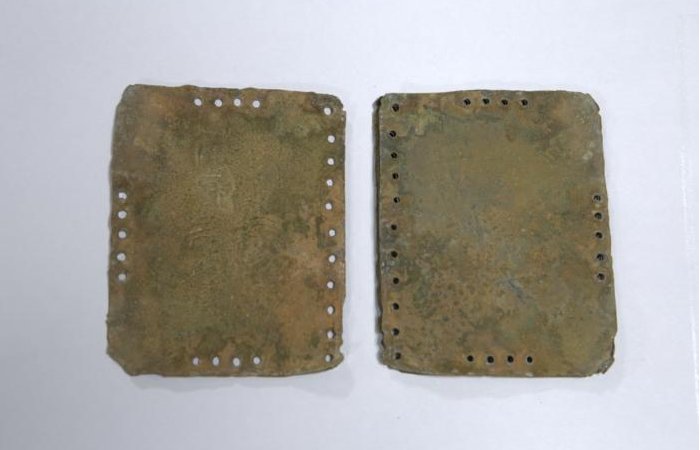
Jordan codices sample. Credit: University of Surrey.
While the study could not confirm that the codices date back to the early Christian period, it also did not provide evidence that they are of modern origin. However, determining their true age remains challenging due to significant inconsistencies in the samples and higher-than-expected background contamination. As a result, more comprehensive investigation is necessary to achieve conclusive results about when these books were manufactured.
“Our aim throughout this work has been to bring rigorous, objective science to a subject that has attracted a great deal of speculation. I have been examining these materials since 2011, and as our analytical techniques have become more advanced, the picture has become more nuanced. Some parts of the codices appear modern, while others show characteristics of older lead that we cannot explain using contemporary materials. We have been unable to prove that they are truly ancient, but we have also not been able to prove that all of the objects are modern. We have seen some codices that have tested to be modern, but others clearly test as older than 200 years – thus as far back as our currently successful tests can go,” Professor Roger Webb, Director of Surrey’s Ion Beam Centre and lead author of the study, said in a press release.
The Surrey Ion Beam Centre is the lead site for the UK National Ion Beam Centre and is equipped with state-of-the-art ion implanters and analysis facilities used across disciplines ranging from quantum technologies to materials science and biosciences.
As part of its mission, the centre also applies ion-beam techniques to cultural heritage and art conservation, including studies of timbers from the Cutty Sark and analyses used to assess whether a ‘Leonardoesque’ painting could be attributed to Leonardo Da Vinci. These capabilities allow researchers to investigate materials at microscopic and atomic scales, providing the precision needed for studies such as this.
“At the Surrey Ion Beam Centre, we routinely apply these techniques to everything from quantum devices to cultural heritage objects, and our study shows just how powerful ion-beam analysis can be.
See also: More Archaeology News
The fact that some key samples cannot be shown to be modern provides a strong scientific basis for scholars to take the codices seriously and for further, more advanced testing to be carried out,” Professor Webb added.
The study was published in Elsevier’s Nuclear Instruments and Methods in Physics Research B: Beam Interactions with Materials.
Written by Jan Bartek – AncientPages.com Staff Writer
Click the Source link for more details
The Decembrists: Russia’s First Revolution
On the cold morning of 14 December 1825 a group of Russian army officers led 3,000 soldiers to Senate Square in central St Petersburg in an attempt to force the tsar’s senate to read their manifesto to the people. That manifesto stated that the tsar had renounced the throne and that the government had been overthrown. It called for a constitution, the abolition of serfdom, and civil rights. After the troops had stood for hours in the wintry square, Tsar Nicholas I, having ascended to the throne just over two weeks earlier, ordered cannons to be brought forward and opened fire on the insurgents. Most were arrested and sent to the Peter and Paul Fortress in St Petersburg. Two weeks later a second revolt flared up among officers of Russia’s Second Army in Ukraine, then part of the Russian Empire. This uprising was brutally crushed by government forces. Following a six-month investigation, 121 ‘Decembrists’, as they later became known, were sentenced to hard labour and exile in Siberia and five of the leaders were executed.
Click the Source link for more details
Stunning Results: Revolutionary Retinal Chip Lets Patients With Severe Vision Loss Read Again
 A wireless implant helped patients with severe macular degeneration regain usable vision. The results point toward a new future for vision restoration. A wireless retinal implant has been shown to restore central vision in people with advanced age-related macular degeneration (AMD), according to clinical trial findings recently released in the New England Journal of Medicine. […]
Click the Source link for more details
Philosopher mask found at ancient theater – The History Blog
 Five theatrical mask reliefs, including a rare depiction of a philosopher, have been discovered in the Roman theater of Kastabala Ancient City, southern Turkey. Masks have been discovered in previous seasons of excavations at the theater site. With this year’s five, the total has now risen to 36.
Associate Professor Faris Demir, the excavation director, said the newly uncovered masks offer significant clues about the artistic practices of the period. Among the latest finds is a striking relief of an elderly philosopher, a discovery he says enhances Kastabala’s importance as a cultural crossroads of Eastern and Western traditions.
Demir noted that philosopher depictions are rarely seen among theatrical mask reliefs. “This figure is strong evidence that the Kastabala Theater functioned not only as a venue for tragedy and comedy but also as a space where philosophical and literary discussions took place,” he said.

Founded in the Late Hittite period about 2,700 years ago. It was a sacred city from its earliest origins. A 2023 excavation uncovered the remains of a 6th century B.C. temple dedicated to the Luwian goddess Kubaba, the first temple to Kubaba ever discovered, although they are known from ancient texts. In the Hellenistic period (ca. 2nd century B.C.), the city had a sanctuary of Artemis Perasia which was unique for its ritual of priestesses walking barefoot on burning coals.
 Kastabala became part of the Roman Empire’s province of Cappadocia in the 1st century. The Roman theater dates to around this time. It had a capacity of around 5,000 people. Excavations of the theater area have unearthed a significant quantity of architectural features from the stage structure. There are large, well-preserved sections surviving, allowing archaeologists to understand the original design of the stage, and perhaps even reconstruct part of it.
Click the Source link for more details