


Jan Bartek – AncientPages.com – The National Research Institute of Maritime Heritage (NRIMH) has announced the successful completion of a significant underwater archaeological project. South Korean archaeologists have retrieved the 600-year-old Joseon-era cargo vessel, Mado 4, from the seabed off Taean in South Chungcheong Province on Korea’s western coast. This operation is notable for marking the first full recovery of a vessel from this period, representing a significant milestone in maritime archaeology.
Mado 4 Recovered After 10 Years

Shipwreck Mado 4. Credit: National Research Institute of Maritime Heritage (NRIMH)
The recovery effort began in 2015 when Mado 4 was initially discovered. Over nearly a decade, experts conducted careful on-site conservation and analysis before raising the ship. Currently, Mado 4 is undergoing desalination and preservation processes in Taean to ensure its long-term stability.
This fully preserved 15th-century ship holds substantial historical significance. It offers valuable insights into the maritime infrastructure of the Joseon dynasty, which ruled Korea for over 500 years. The excavation of Mado 4 provides unprecedented physical evidence of the kingdom’s advanced sea-based tax collection and transportation systems during that era.
Green Pottery
The ship contained a significant collection of treasures. Among the discoveries were 87 celadon pieces, a distinctive greenish ceramic produced in royal workshops. Initial investigations at the wreck site uncovered over 120 valuable artifacts. These included high-quality porcelain intended for government tribute payments, crates packed with rice, and wooden tags indicating specific destinations for the cargo.

Green pottery was found on Mado 4. Credit: National Research Institute of Maritime Heritage (NRIMH)
Researchers, including specialists from South Korea’s Cultural Heritage Administration, have verified that the Mado 4 was an active part of the joun, a crucial state transportation network during its time. This system played a vital role in moving grain and official goods from regional storage sites to Hanyang (modern-day Seoul).
Dangerous Route
Evidence suggests that the vessel likely sank around 1420 while traveling from Naju, a significant grain collection center in South Jeolla Province. The route was known for its hazardous conditions—strong tides and rocky passages—which not only posed navigation risks but also contributed to the vessel’s exceptional preservation beneath layers of silt and sand.
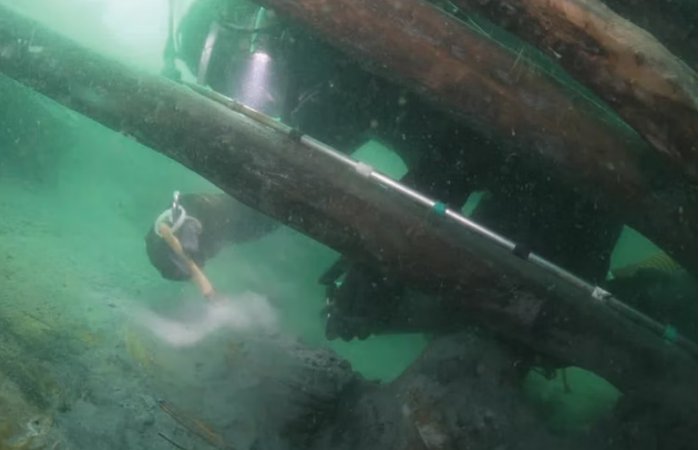
Underwater archaeologists examined Mado 4. Credit: National Research Institute of Maritime Heritage (NRIMH)
The Mado 4’s structural features provide valuable insights into the era’s naval engineering practices. Unlike earlier Korean ships that typically had a single mast, this vessel employed two masts—a design believed to improve both speed and maneuverability.

Wooden pieces are inscribed with ‘Naju Gwangheungchang,’ indicating both the destination and the departure point of the ship. Credit: National Research Institute of Maritime Heritage (NRIMH)
Additionally, researchers identified repair work using iron nails on the ship, marking the first confirmed use of metallic fasteners in traditional Korean shipbuilding. Such findings shed light on technological advancements during the Joseon dynasty and offer new perspectives on maritime logistics during the period.
See also: More Archaeology News
Notably, investigators also found evidence of another sunken ship nearby. Preliminary analysis dates this second wreck to between 1150 and 1175 CE, potentially linking it to the Goryeo Dynasty period. If confirmed, it would predate Mado 4 by more than two centuries and become Korea’s oldest known shipwreck. Selected artifacts recovered from these sites are currently displayed at Taean Maritime Museum as part of “Ship of the Nation Sailing the Sea,” an exhibition open until February 2026.
Source: National Research Institute of Maritime Heritage (NRIMH)
Written by Jan Bartek – AncientPages.com Staff Writer
Click the Source link for more details
